The price of commitment
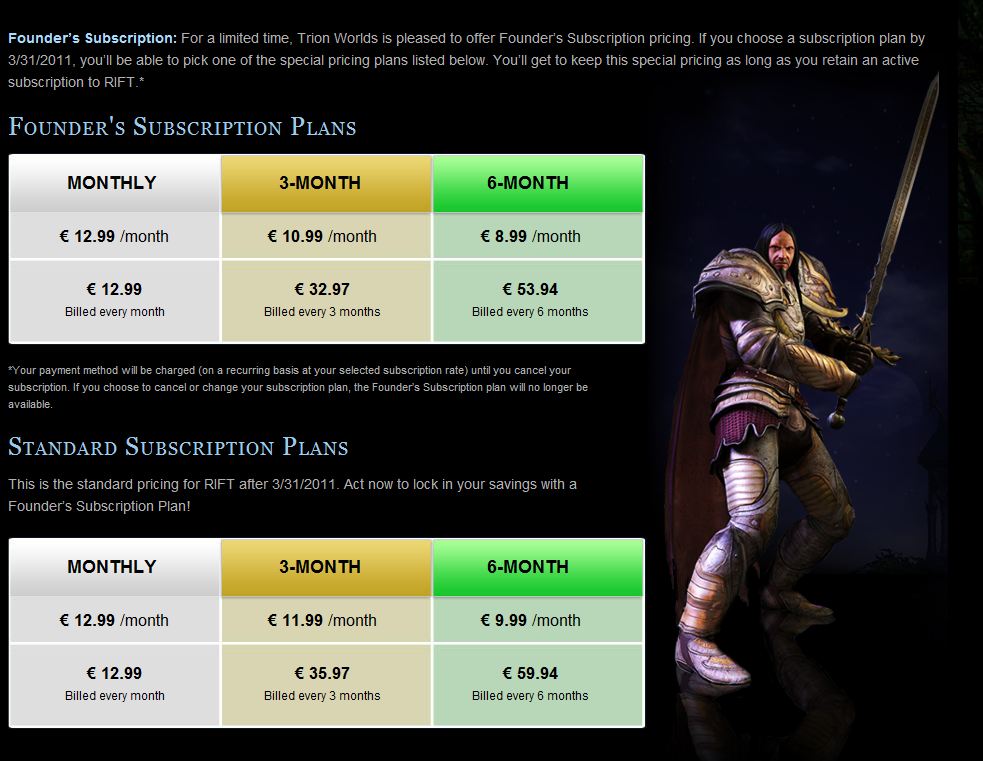
 The recently launched RIFT, a big-budget subscription MMO, has been offering a very deep discount for 3- and 6-months subscriptions set up early (the Founder pricing, normally valid for the first 2 weeks after release, which has been extended to the end of March). Discounts for longer subscriptions are the norm in the industry, and such an offer has been proposed before by other games. These limited offer at a very low price are really interesting.
If you sign up for 6 months subscription for Rift relatively early, you would pay $9.99 / 9.99€ / £5.99 a month instead of the normal price of $14.99/ 12.99€/ £8.99, a discount of respectively 33% for US and UK players and 23% for the German and the French. (Side note : There might be payment processing fees-related reasons other than just getting away with making Euro players pay more – even if, since most of the competition is doing it, it is indeed possible to get away with it. Similarly, the common price for a MMO subscription is now 25% undervalued in GBP, as this "standard" price was decided at WOW's release, when the pound was worth about 1.45€, compared to now when it's only worth 1.15€. At today's rates, $14.99 should translate to 10.5€ and 9.1£. But by now, the European players are used to paying more and the British to paying less, and anyone lowering the Euro price would leave money on the table while anyone increasing it in the UK would not be competitive*. Fun stuff, and end of side note.) This type of offer, similarly to the « lifetime subscriptions » used by other subscription MMOs (a lump sum, generally available only before or shortly after the launch of an MMO), have an evident goal : trading a part of the profits in exchange for certainty, thus sharing the risk between the operator and the player. If the player loves the game and ends up playing it for a very long time, the studio loses a share of the margin. But if the player leaves the game sooner than what he commited to (the duration of the subscription, or the break-even point in case of lifetime subscription), or if the game closes before that, then the operator has earned more than it should have. In all cases, if cash-flow is uncertain, as it can be really common after a long development, generally over time and budget, and in a context of anxiety about launch results, the cash is more valuable to the studio sooner than later.