Is an April fools’ joke a good PR tool for your game?
Traditionally, on every April 1st countless game makers pull off April fools’ jokes, with at least as many gamers and more importantly media laughing or complaining about them. This raises the question of whether cooking up an April fool’s joke could be more than just an enjoyable team building exer
The unamusing data analysis of four recent examples
[Update: The Rocket League team have been in touch with and clarified this year's April Fool's prank was - unlike the assumption made by us and several other news outlets - not actually made by them, but rather a community site. We added an additional paragraph in the Rocket League section on this post to reflect this.]
Traditionally, on every April 1st countless game makers pull off April fools’ jokes, with at least as many gamers and more importantly media laughing or complaining about them. This raises the question of whether cooking up an April fool’s joke could be more than just an enjoyable team building exercise, and actually be a strong PR tool for your game? The short answer: yes! Just kidding: like almost everything in PR it depends on circumstance.
To try answer the above question more in-depth, we analysed some general data from this year’s jokes. We also examined four very different examples in greater detail. The data below should hopefully help you decide whether participating in next years April’s fool’s fun is worth your PR resources.
2016’s April pranks PR performance comparisonIn the graph below you can see the general ranking of this year’s April fools’ jokes according to how many articles they generated in media. For more info on the tracking method please read this entry. Please also note that this selection excludes several jokes - such as Hearthstones fake MMO - due to it being a too much of a generic name for our tool to track consistently. Furthermore, other stunts that didn’t get enough coverage to be tracked, were also excluded.
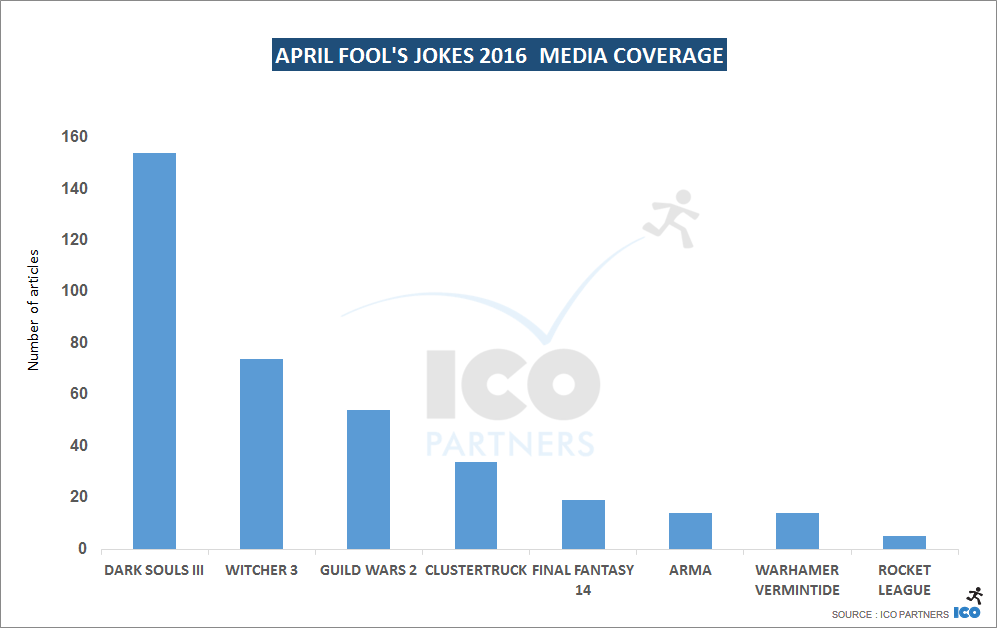
If you are interested in what the actual joke for the games in the graph were, I have listed links to them at the very end at the article but now back to the coverage graph. Unsurprisingly, big brands like The Witcher 3 and Dark Souls III led the coverage charts. However, the fact that a small title like Clustertruck gained more traction than big brands like Final Fantasy 14 and most notably Rocket League, shows that a strong name doesn’t necessarily guarantee coverage when the idea or execution of the PR stunt isn’t quite right.
In the four example case studies analysed, we take a look at what helped or hindered these stunts. But first let’s have a quick look at how the different games' related videos performed on YouTube.
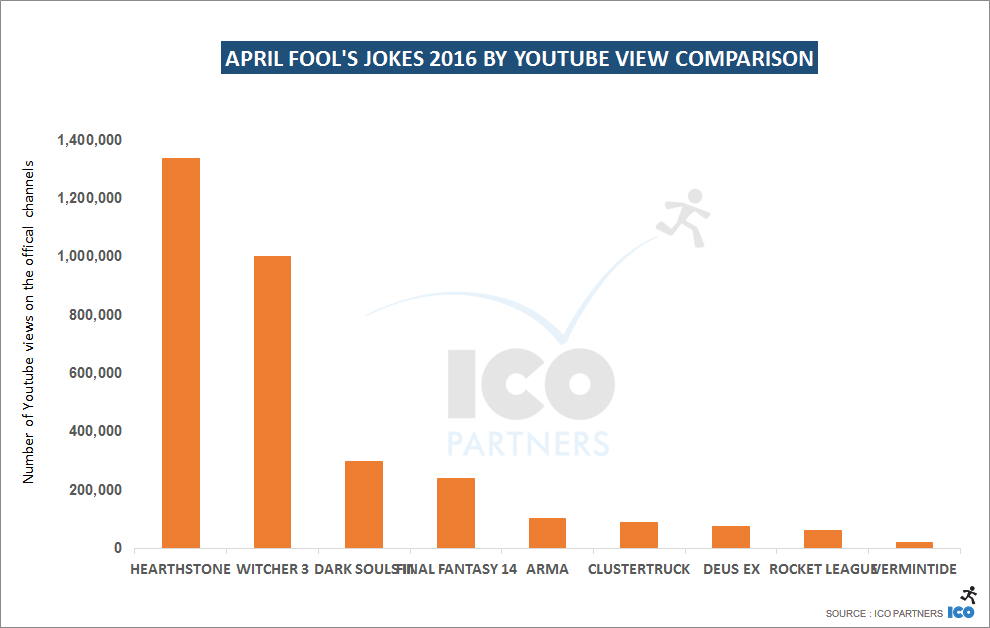
As mention before we couldn't track Hearthstone's MMO joke in terms of coverage but it still included in the Youtube overview graph which it is leading - most likely due to Blizzard's strong community. While Dark Souls III was a very hot topic in the number of articles it was featured in, it was far less popular on YouTube compared to the Witcher 3. One explanation for this could be that news outlets were eager to pick up on the Dark Souls III news, as the game was due to be released a week after. Therefore, references to Dark Souls III would most certainly generate traffic on articles. However, in reality the audience wasn't too impressed by the video itself, leading to the smaller numbers of views.
The big difference in coverage and YouTuber numbers could also be related to a variety of other factors, such as the Witcher 3 simply pushing video content more or having a stronger YouTube community.
Lets look at our four, hand-picked examples in a bit more detail.
Case Study 1The Witcher 3: Wild Hunt with "Roach"